
Performing Workers’ Rights in the Dutch Caribbean
Artists Quinsy Gario (b. 1984, Curaçao) and Glenda Martinus (1951–2025) address resource extraction and workers’ rights in relation to the oil refineries of Curaçao.
In 1912, Royal Dutch Shell acquired a concession to search for oil in Venezuela, east of Lake Maracaibo. Initially, the company’s presence in Venezuela produced a modest amount of oil, which Shell stored in a small facility on the Caribbean island of Curaçao. By 1915, however, oil production had increased significantly, prompting Shell to establish the Isla refinery in Willemstad, the island’s main city. For decades, the company was Curaçao’s largest employer. In 1985, for the symbolic sum of four guilders, Shell transferred ownership of the facility to the island’s government. Until 2019, the plant was owned by the government of Curaçao but run by Petróleos de Venezuela, S.A. (PDVSA).
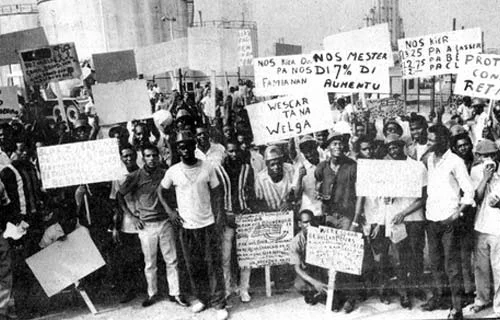
In their performance Whiskey in a Crate, artists Quinsy Gario (b. 1984, Curaçao) and Glenda Martinus (1951–2025) address resource extraction within the Dutch Caribbean through its repercussions for social justice. The performance is a spatial reenactment of the labor strike on 30 May 1969, later known as Trinta di Mei (Thirtieth of May). A small maquette of the Isla refinery and the route of the protesters, which was made up of union members, laborers, and their supporters, accompanies a personal retelling of the events that day. With a focus on spatial segregations—exemplified by a supermarket for the elite in a neighborhood solely for Dutch employees—Martinus and Gario intertwine the accounts of witnesses with commentary on social and racial hierarchies in relation to the company structure of Shell and its long life on Curaçao.
In an interview, Gario described the work’s historical context: “After a brief occupation of Curaçao by the English, the Kingdom of the Netherlands—formed in 1812—took control of the islands in 1814, and they officially remained a colony until 1954. During this period, centralized authority from the Netherlands set the tone, and in 1915, Shell was granted permission to shape the island to its liking. Historically, the island’s administration has had a tendency to hand over control of the island to companies and investors.”
Krista Jantowski