
Common Ground: Reconnecting with British Landscapes
Established in 1983, the British charity Common Ground is one of the oldest organizations operating at the intersection of art and environmentalism.
Established in 1983, Common Ground supports artists in a variety of creative domains in order to promote the “local distinctiveness”—or peculiar character—of landscapes across Britain (Common Ground, n.d.). The organization insists that ordinary places are no less deserving of attention than sublime or wild landscapes, and much of their work concentrates on localities excluded from government-protected areas: “A primrose bank here, a millpond there; an orchard or a bluebell wood; a network of hedges full of familiar birds and mammals, all of which give a place a character and a feeling” (Smith 2016). One of the oldest organizations operating at the nexus of art and environmentalism, Common Ground deliberately eschews “numbering things, counting, [and] making factual arguments,” focusing instead on “our emotional . . . relationships with the things around us” (Common Ground 2017, 3:13).
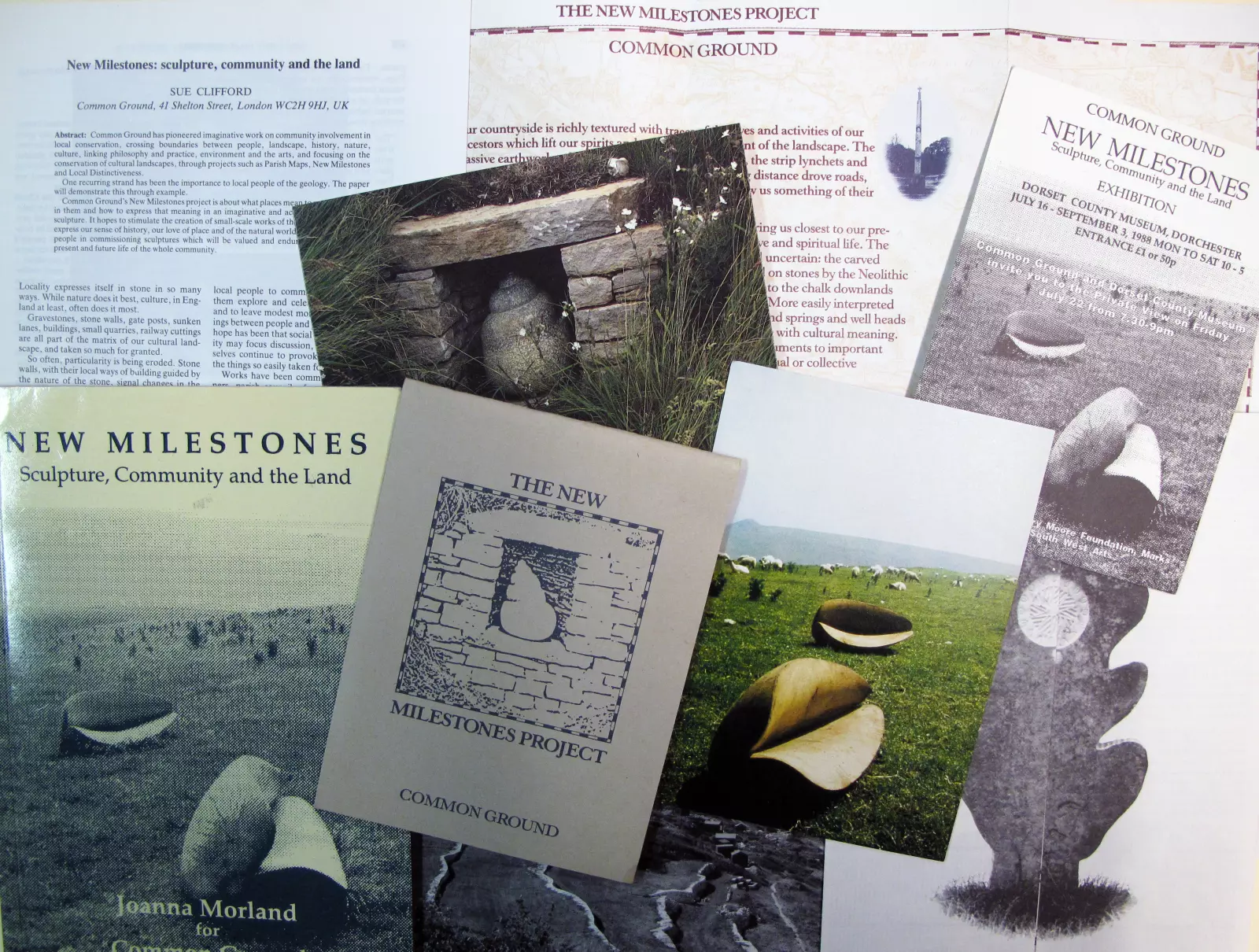
Since its inception, Common Group has collaborated with some of Britain’s best-known artists, including Anthony Gormley (b. 1950, London), David Hockney (1937–2026), Richard Long (b. 1945, Bristol), Henry Moore (1898–1986), and David Nash (b. 1945, Surrey). In 1985–86, they awarded Andy Goldsworthy (b. 1956, Cheshire), then only twenty-nine years old, a six-week residency in conjunction with an exhibition of his work below the organization’s office on Shelton Street, in London (Smith 2016). Around the same time, they arranged for Peter Randall-Page (b. 1954, Essex) to produce a succession of shell-shaped sculptures along a bridleway on the southern coast of Dorset as part of the organization’s New Milestones project. Fashioned of “Purbeck Marble” (limestone quarried on the Isle of Purbeck), each sculpture was installed in a niche that was partially buried in the grassy landscape and could easily be missed by ramblers. Randall-Page has said of his demure sculptures that “the idea of trying to compete in any way, in terms of scale, with this place would be arrogant and doomed to failure as well” (Mark 2014). The artist’s wayside carvings, which are still in place on the Dorset coast, play with deep time by echoing the form of primordial gastropods entombed in the area’s chalk cliffs. At the same time, they function as a kind of memento mori in that they are composed of a brittle material that, in the words of Randall-Page, is “not, strictly speaking, an outdoor stone” (Mark 2014).
Notwithstanding their work with well-established artists, Common Ground may be best known for its Parish Maps Project, which invited members of the public to chart the “local distinctiveness” of their home areas (be they neighborhoods, villages, districts, or other localities imbued with a sense of familiarity and belonging). The parameters of the project were deliberately fluid, allowing participants to reconnect to a home area on their own terms: “Parish Maps are . . . subjective statements made by and for a community, exploring and showing what it cares about in its locality. . . . Parish Maps can be made by anyone in any way, of any place” (Price 2019). Over a ten-year period, the project led to the creation of thousands of parish maps, culminating in the exhibition from place to PLACE: an Exhibition of Peoples’ Parish Maps, which was displayed at the Barbican Centre, in London, in 1996.
Even though Common Ground was founded before climate change had begun to permeate the popular imagination, its focus on “local distinctiveness” prefigures the situated turn in climate-change discourse. In his discussion of situated design, Michel van Dartel notes that “a situation [such as climate change or social injustice] can only be fully understood on the basis of an embodied experience of it. Anything else will fail to completely do justice to the problem being addressed” (Van Dartel 2016, 22). An ancillary benefit of a situated practice is that it allows for artists (and the public) to engage with climate change without being paralyzed by the global scale of the problem. In the words of Sue Clifford, one of Common Ground’s founders: “Most people, when they’re confronted by the idea that there’s a global problem in environmental terms, are stricken into a catatonic state of incapability” (Common Ground 2017, 20:14).
Christopher Snow Hopkins
References
Common Ground, n.d.
“What We Do.” Accessed 11 August 2026. https://www.commonground.org.uk/what-we-do/.
Common Ground 2017
“On Common Ground.” Common Ground Cinema, 26 September 2017. Vimeo, 25 min., 16 sec. https://vimeo.com/235554330.
Mark 2014
Mark, Helen, host. Coast and Country. “Common Ground, Dorset.” BBC Radio 4, 6 February 2014.
Price 2019
Price, Annie. “Cataloguing the Common Ground Archive: ‘Parish Maps.’” University of Exeter Special Collections, 12 April 2019. https://specialcollections.exeter.ac.uk/2019/04/12/cataloguing-the-common-ground-archive-parish-maps/.
Smith 2016
Smith, Jos. “Common Ground—History.” Accessed 7 August 2026. https://www.commonground.org.uk/history/.
Smith 2017
Smith, Jos. The New Nature Writing: Rethinking the Literature of Place. London: Bloomsbury Academic, 2017.
Van Dartel 2016
Van Dartel, Michel. Aesthetics in the Wild: Art and Design Practices and Pedagogies after the Situated Turn. Avans: Avans University of Applied Sciences, 2016.