
Marjolijn Dijkman: Deconstructie van de mythologie van de moderniteit
Marjolijn Dijkman’s practice interrogates the nexus of power, knowledge, and ecological degradation.
Marjolijn Dijkman (b. 1978, Groningen) engages in rigorous research to expose “hidden stories and overlooked connections among power, knowledge, and environmental transformation, revealing the biases embedded in scientific and cultural myths” (Dijkman, n.d.). Her approach to medium is omnivorous, encompassing sculptures made of shrapnel, jerry-rigged Tesla coils, flasks of brackish water linked in a custom metal framework, reproductions of primordial meteorites, and a robotic drum corps. In 2005, she cofounded the artistic research collective Enough Room for Space, whose objective is to operate “as freely as possible, always putting the context and the idea before the medium, challenging the barriers between different disciplines (artistic, scientific or activist)” (FramerFramed, n.d.). In keeping with this aim, her practice oscillates between “the factual and the fictional,” building speculative worlds from data gathered through archival work, fieldwork, and experimentation (Dijkman, n.d.).
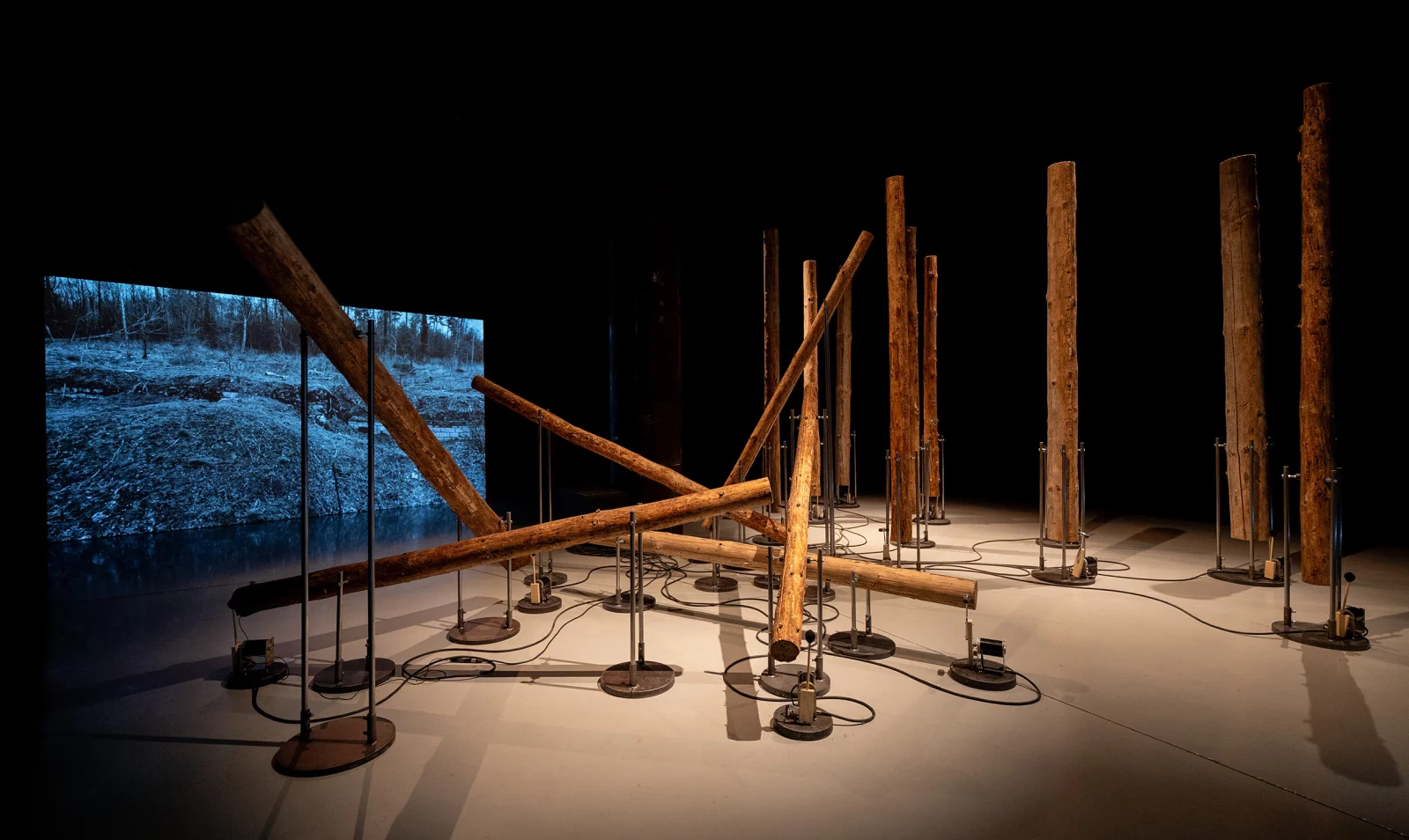
Between the Lines (2021–25)—a multiyear project centered on the Zone Rouge (Red Zone), in northeastern France—addresses the collision of present-day ecological concerns with the legacy of human conflict. This area of Verdun saw intense fighting during World War I and was at one time contaminated by noxious chemicals such as arsenic, chlorine, and phosgene. The remains of some eighty thousand soldiers are buried in the forested landscape, and the treacherous zone is booby-trapped with twelve to fifteen million unexploded shells. (French farmers ploughing their fields regularly dig up these munitions—this deadly bounty is known as the “iron harvest.”) After the war, the battle-scarred landscape was planted with rows of Norway spruces that primed the area for an infestation of European bark beetles in the summers of 2018 and 2019. This concatenation of events—war, monocropping, pestilence—is the subject of three works by Dijkman related to non-linear time. The first, Between the Lines (2024–25), pairs robotic percussionists drumming on the trunks of felled spruces with a film splicing together historical photographs of the Verdun, LiDAR images of the cratered landscape, and close-ups of dead trees inscribed by the mandibles of the invasive beetles. The second work—Iron Harvest (2024)—is a sculpture fashioned of shrapnel that is “strangely reminiscent” of spruce bark (Dijkman 2025, 198). The final work—Déja Vu (2023)—is a facsimile of a dead beech tree in the Zone Rouge that stands beside its prototype like an evil twin. Fashioned of shrapnel, the counterfeit beech harks back to the WWI-era practice of building covert observation stations in the guise of trees.
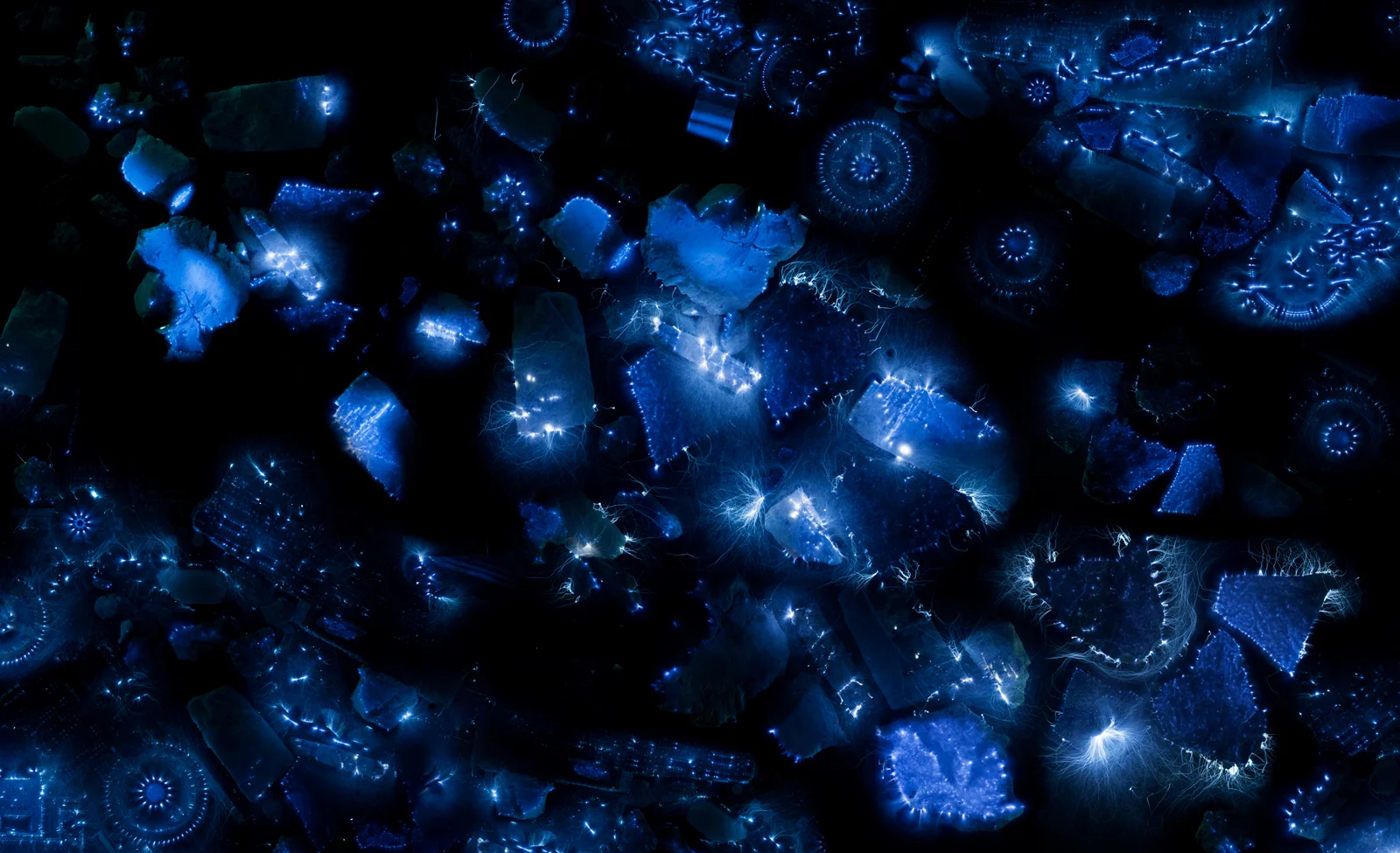
In line with her interest in the folds and perturbations of time, Dijkman also charts the afterlife of “Enlightenment ideology” and its implications for the present (Dijkman, n.d.). Earthing Discharge (2020), for instance, reconsiders Benjamin Franklin’s conception of electricity by visualizing the corona discharge of lithium ore quarried in Manono, a mining town in the Democratic Republic of the Congo and the epicenter of a global race to hoard the precious metal. In these photographs, lithium-laced spodumene minerals shimmer like nebulae or bioluminescent plankton. The artist’s intention in creating this work was not only to probe “the pre-scientific staging [of electricity] as a spectacle” but to interrogate the alliance between the impulse to know and the desire to have (Arndt and Gueye 2020, 39). For Franklin, who laid the foundation of electrical science, electricity was not only a means to assert humanity’s dominion over the natural world but a way to alleviate poverty (Arndt and Gueye 2020, 39).
Dijkman’s wide-ranging oeuvre is not limited to shrapnel sculptures and lambent lithium but also includes a titanium copy of a Pleistocene meteorite (held by a bronze cast of a human hand), a film in which microorganisms from a Norwegian fjord are seen through an optical microscope, and a reproduction of the table around which the Lunar Society—an eighteenth-century clique of academicians in Birmingham—gathered every time there was a full moon. The artist is currently doing research into “cyber-polder landscapes,” or the intersection of estuaries and computational thinking. A Mentor Artist for the JUST ART consortium, she is based in Brussels, Belgium, and Lahaymeix, France.
Christopher Snow Hopkins
References
Arndt and Gueye 2020
Arndt, Lotte, and Oulimata Gueye. “On-Trade-Off: Countering Extractivism by Transnational Artists’ Collaborations.” Commodity Frontiers: Capitalism, Contestation, and the Transformation of the Global Countryside 1 (2020): 32–42.
Dijkman, n.d.
Dijkman, Marjolijn. “About.” Accessed 29 May 2026. https://www.marjolijndijkman.com/about.
Dijkman 2025
Dijkman, Marjolijn. “Between the Lines: Artistic Research by Marjolijn Dijkman.” In Forest Encounters, edited by Urška Jurman and Mateja Kurir, 190–201. Ljubljana and Berlin: Igor Zabel Association for Culture and Theory and Archive Books, 2025.
Framer Framed, n.d.
“Marjolijn Dijkman.” Accessed 29 May 2026. https://framerframed.nl/en/mensen/marjolijn-dijkman/.