
Allora & Calzadilla: Bestrijding van extractief geweld in Puerto Rico
Allora & Calzadilla exploit a range of media to trace the entanglement between the human and the more-than-human.
Allora & Calzadilla is a duo comprised of Jennifer Allora (b. 1974, Philadelphia) and Guillermo Calzadilla (b. 1971, Havana). The pair deploys various media—video, performance, photography, sculpture, and sound—to investigate a range of ecological issues, in particular the entanglement of the human and the more-than-human. The artists have said that “our medium is the trace,” describing their practice as one of “marking and effacement . . . that unsettles any linear relation between past, present, and future” (McKee and Mansoor 2010, 48).
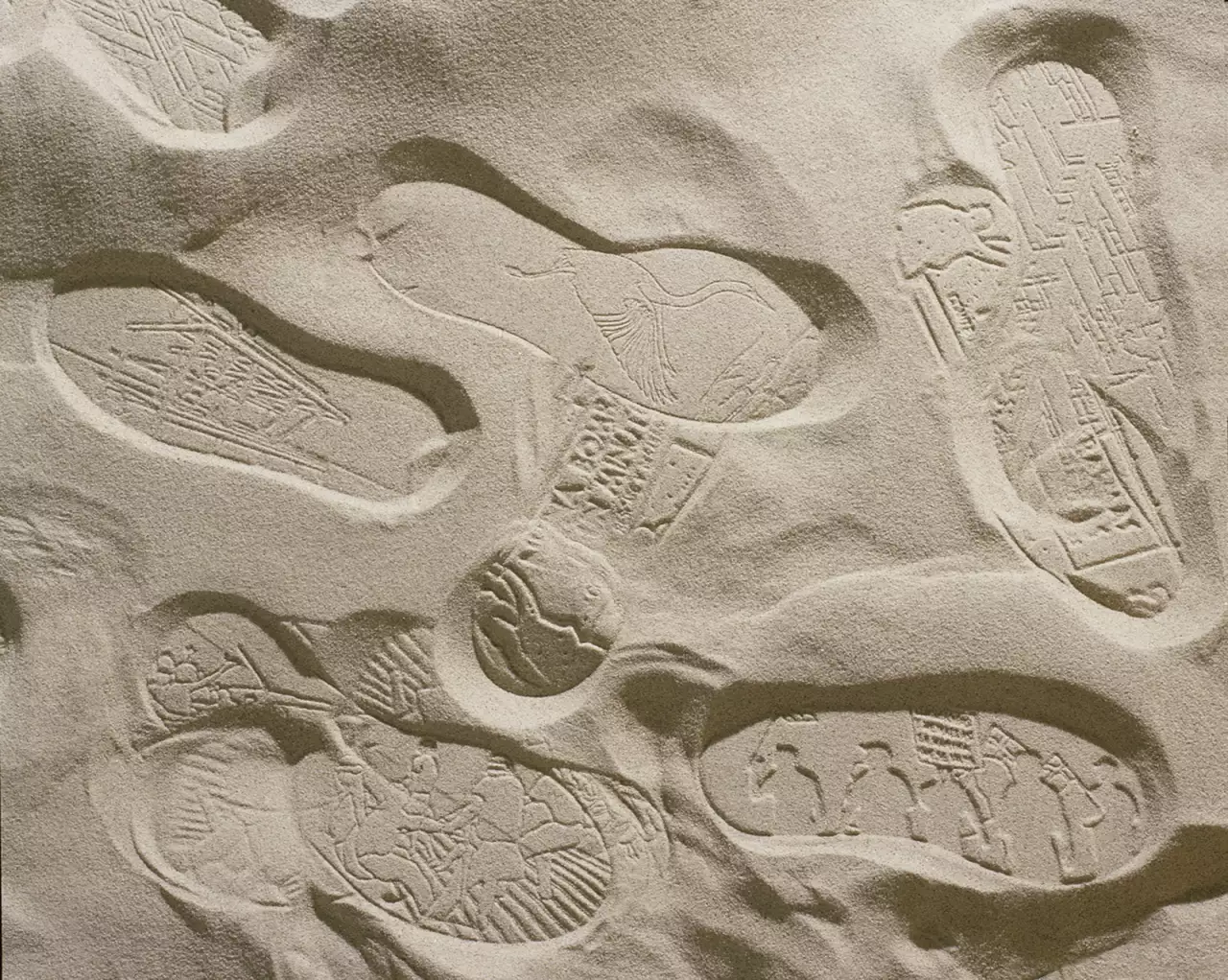
This process of marking/effacement is at the heart of Land Mark (Foot Prints), which documents a performance and act of civil disobedience by the artists in 2002. Accompanied by activists, they infiltrated a U.S. Navy installation on the Caribbean island of Vieques, where they inscribed evanescent marks on a bomb-testing site by treading on the sand with rubber stamps attached to the soles of their shoes. Their incursion into the Vieques Naval Bombing Range was not meant to subjugate alien terrain but to restore the territorial integrity of the islanders: “The ephemeral markings did not claim the Vieques Range as a conquest (or even a re-conquest), but simply made visible claims about the space’s rightful place in the islanders’ everyday geographies” (Bobrow-Strain 2015, 129). The subversive markings embossed on the damp sand “made a diverse cacophony of impressions,” reflecting the heterogenous perspectives of the ragtag coalition of activists mobilized by the artists (Bobrow-Strain 2015, 129). Implicit in acts of civil disobedience such as Land Mark is a reimagining of sustainability so that it encompasses questions of social justice (McKee 2007, 25). In this sense, Land Mark may be construed as a tactical mobilization of art to topple unjust ecopolitical regimes.
In other works, the artists have staged encounters between the human and more-than-human to probe their “likenesses and unlikenesses” (Scott 2014, 17). Such was the case with Raptor’s Rapture (2012), a video in which a Eurasian griffon vulture (Gyps fulvus) appears alongside a musician playing a prehistoric woodwind fashioned from the wing bone of the same species. The objective of this video is not only to query non-human subjectivities but to situate humanity in deep time—a geological timescale spanning billions of years. In this case, the presence of the griffon vulture evokes the fifth and most recent extinction event in the earth’s history, when a massive asteroid collided with the planet and wiped out three-quarters of its plant and animal species. The only dinosaurs to survive this cataclysm were the primeval theropods from which modern birds (including the hooked-beaked protagonist of the video) are descended.
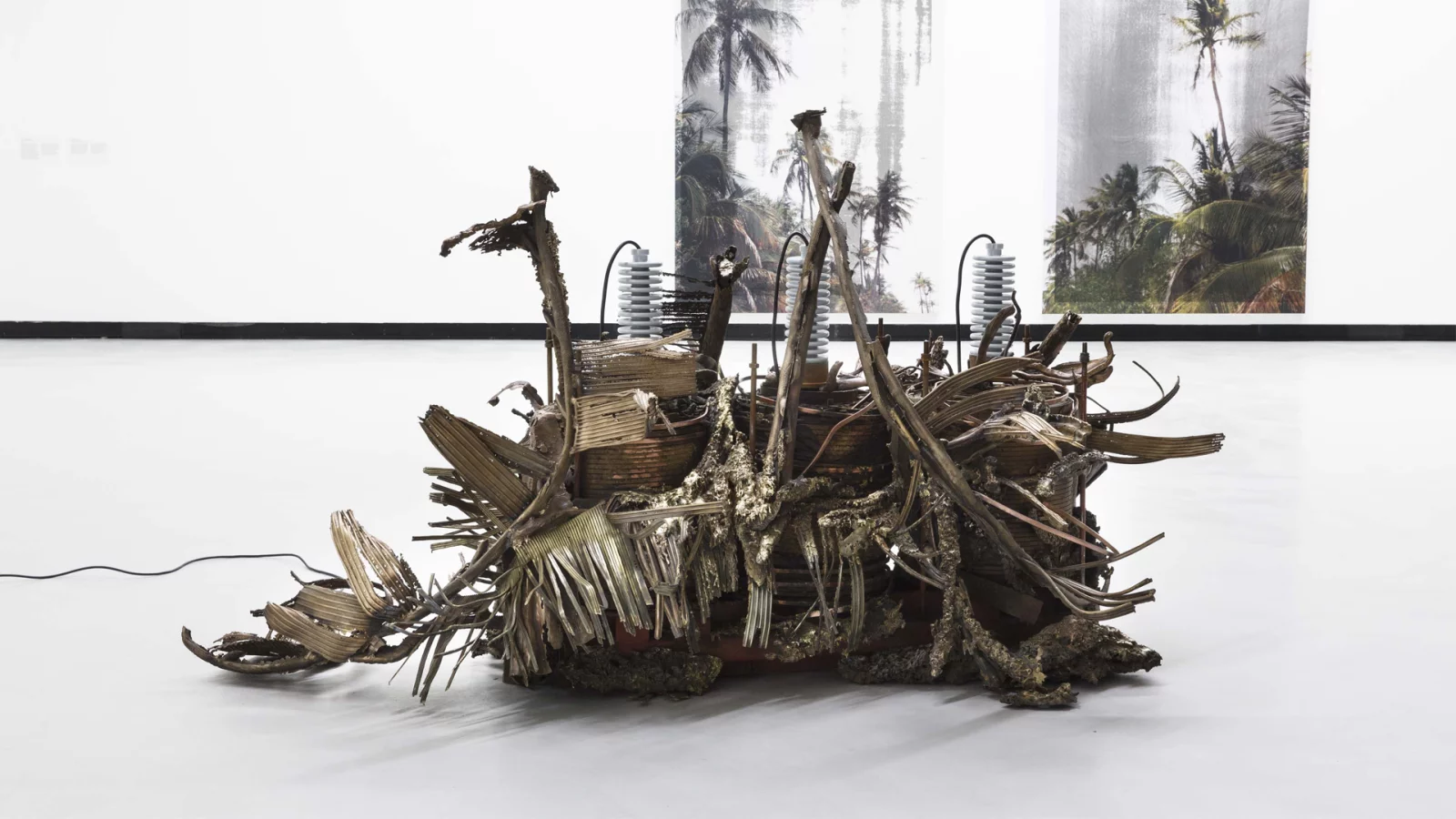
Apart from their interrogation of deep time, Allora & Calzadilla have taken aim at petrocapitalism, satirizing humanity’s unquenchable thirst for fossil fuels. In 2010, they fabricated a series of life-size petrol pumps that resemble technofossils (the petrified remnants of humanity entombed in the earth’s crust). Carved from limestone, the works present themselves as future artifacts, or “vestiges of the oil world that might be discovered by visitors to a future archaeological site” (Lille 2022, 27). Here, as elsewhere, the artists have subverted the “linear relation between past, present, and future,” in this case by framing the present as an era long past. Their aim is to advance climate justice or, put another way, to combat climate injustice. Another sculpture—the mutilated form of an electromagnetic power transformer—alludes to “the scars of past and ongoing extractive violence in Puerto Rico” (Demos 2020, 60). Even as Puerto Rico confronts the ill effects of climate breakdown, its economy has been hobbled by massive debt (owed to investment firms and vulture hedge funds on the U.S. mainland), leading to the concurrent despoilation of the tropical island and the immiseration of its inhabitants.
The two artists, who have been collaborating since 1995, live and work in San Juan, Puerto Rico.
Christopher Snow Hopkins
References
Bobrow-Strain 2015
Bobrow-Strain, Aaron. “On Allora & Calzadilla, Land Mark (Foot Prints) (2001–2).” In Critical Landscapes: Art, Space, Politics, edited by Emily Eliza Scott and Kirsten Swenson, 128–30. Oakland: University of California Press, 2015.
Demos 2020
Demos, T. J. Beyond the World’s End: Arts of Living at the Crossing. Durham, NC: Duke University Press, 2020.
Lille 2022
Novacène: Art and Climate Crisis. Exh. cat. Lille (Gare Saint Sauveur), 2022.
McKee 2010
McKee, Yates. “Wake, Vestige, Survival: Sustainability and the Politics of the Trace in Allora and Calzadilla’s Land Mark.” October 133 (2010): 40–48.
McKee and Mansoor 2007
McKee, Yates, and Jaleh Mansoor. “The Sediment of History: An Interview with Allora & Calzadilla.” Parkett 80 (2007): 42–48.
Scott 2014
Scott, Emily Eliza. “Feeling in the Dark: Ecology at the Edges of History.” American Art 28, no. 3 (2014): 14–20.